“Hard Times Hundred and One” is my project to create 101 original Americana songs inspired by photographs from the Great Depression. “Volume 1” includes 10 songs that focus on the theme of “Life and Love in Hard Times.”
This release was made possible by using Suno to reduce the time from lyrics to studio-grade multi-instrumental and vocal tracks by orders of magnitude. By way of comparison, a two-track song that’s just me and a guitar would take about an afternoon in my studio. A multi-track, multi-instrumental song more like a week.
On this page, you can listen side by side to some of the songs as produced 100% by me and as produced by me providing lyrics and prompting Suno as an AI-vocalist and band. I’ll share what my experience has been like adopting a hybrid creative process, too.
(For access to the full album on Spotify, go here; for additional streaming services, check out this page here.)
Man Must Work to Live
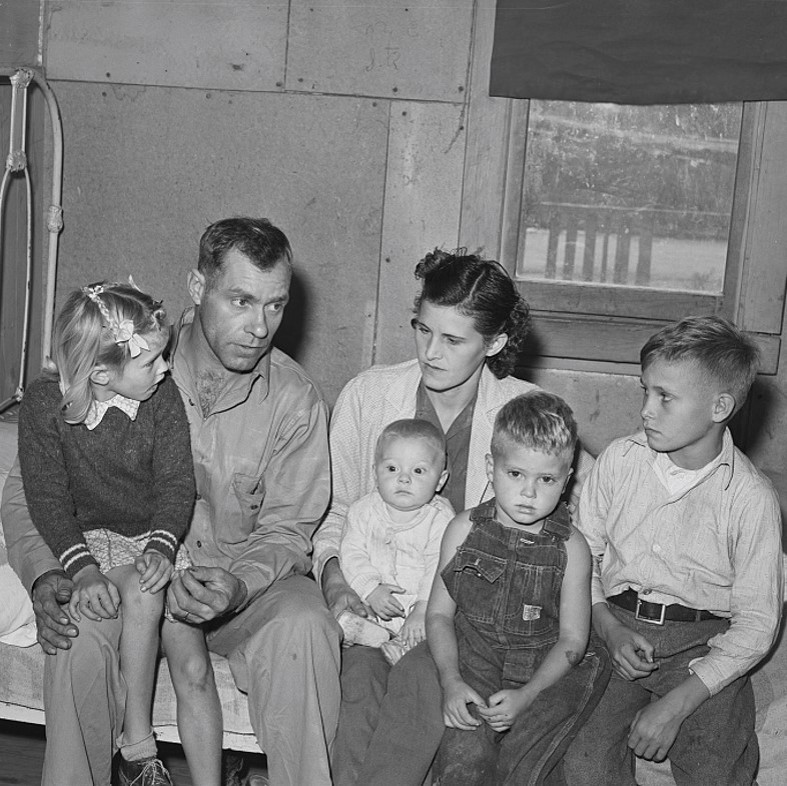
Me, Myself, and I:
Me, Myself, and AI:
My original conception of how to treat MMWTL was as a simple and spare vox and guitar treatment. I still like it. With that said, what Suno did with the unaltered lyrics was nearly flawless out of the gate. The AI’s musical treatment makes perfect sense from my perspective. (The process: the version released on this album came easily out of the first couple prompts.)
What are Working Folks to Do?
Me, Myself, and I:
Me, Myself, and AI:
So, in defense of us humans, getting to where we wound up with WAWFTD took some doing, and the original still have one edge. The AI got off beat in the “when the boss shut down the factory” section, requiring some tweaking of the lyrics. And I included some guitar riffs inspired by Pink Floyd in the original, which the AI–as least as I prompted it–trying to pattern match with Americana songs didn’t (and probably won’t if I keep trying) come up with a similarly clever (if I say so myself) mix of influences. With that said, the me + AI version is a delight. Once again, everything it did makes sense. And as a vocalist it has a vastly greater range than I do. It’s everything the song should be. (Process: Getting close to the version took about a half dozen prompts, after which I was able to dial in on making some changes to the lyrics that resulted in this version.)
How’s a Man to Find Hope in This Hard Time? (and also: Hard Times for the Working Man Blues)

Me, Myself, and I (the How’s a Man to Find Hope in These Hard Times? version):
Me, Myself, and I (the Hard Times for the Working Man Blues version):
Me, Myself, and AI:
This is the most fascinating track from a creation and co-creation perspective. The lyrics I gave to the AI for this album were those of the How’s a Man to Find Hope in These Hard Times? version of the song that I’d previously recorded solo. In this case, the AI needed a lot of help from me editing lyrics to arrive at a coherent and consistent melody and rhythm–which I’m not mad at. Where we wound up is most definitely not a worse song, it’s just a bit different. With that said, here’s the interesting thing about hybrid workflows: the origin of the Hard Times for the Working Man Blues version of the song was me starting with a pre-recorded drum track as inspiration. I started working on adapting the lyrics and building the instruments “on top of” the pre-recorded canned drum track I’d bought (a common thing–you could get sound libraries well before AI!). (Process: I have at least a dozen versions of this song, some of which did not work well at all. After that half-dozen, I was able to dial in to revising the lyrics to produce this version after a few more attempts.)
Some Initial Personal Reflections
Coming into my first serious use of AI to create music as someone whose home base for doing so is “writing lyrics” was profoundly delightful. I have seldom felt such joy. There were two reasons.
Let’s start with the nice-to-have. I am never going to win any awards for my vocal range. So, my AI vocalists can do things I simply can’t and won’t ever be able to do. That’s cool. Great even. But at the end of the day, I could live without that feature.
If you’re a lyricist first, Suno’s killer app is time.
Even on vocals, where the AI is quite slick as varying reverb and doubling and other engineering tricks, I could do that in my studio…with enough time. With soooo much time…
Instrumentally, the AI did not produce anything I couldn’t have produced with my own hands and pre-AI music software (e.g., programming drums). If I wanted to, I could go in and improve on guitar and harmonica parts…with time. The nature of trying to do clever, innovative, and moving riffs and solos means taking lots of time. Sometimes it is well worth it.
Sometimes it doesn’t actually add much to the song–a song which might never make it to a studio-grade album for lack of time.
When I started Hard Times 100 and 1 in 2008, I thought recording 101 original songs was ambitious but possible before I died. Now I’m wondering whether it could 101 albums.
Thanks for listening and reading. There’s more to come!
 Hard Times Hundred & One